

MZ, August 24, 2026
Disclosure: I own Microsoft directly, a legacy of the nine years I spent working there. My Amazon and Alphabet exposure is through index funds. Most of those nine years were spent selling Azure, which is the reason I think I can tell you something useful about how these contracts get written.
I have seen this claim made by a lot of commentators, Ed Zitron among them, and I wanted to get to the bottom of whether it is actually a fact. The (critic's) premise is that OpenAI and Anthropic do not have real end customers, so if the hyperscalers' AI revenue growth comes from just these two labs, then that growth is not robust and it is not permanent.
It sounded a little fishy to me. I worked inside Microsoft for nine years, and during that period the growth on the Azure business was astonishing and it had nothing to do with AI. The core cloud business was simply a very strong business growing very fast. The idea that the growth is now suddenly dependent on two AI labs sounded suspicious. It would mean that AI is large enough to distort a massive oligopoly business (Cloud Compute Infrastructure), and that sounds implausible.
So this piece works the question from the public filings, to see how much we can actually discern about what is going on and the magnitude of the AI lab impact.
Workings to follow.
A primer on enterprise cloud contracts
The huge contracts signed by OpenAI and Anthropic keep getting cited as the evidence that the labs are driving hyperscaler growth. So let me start with how those contracts are typically structured. I spent nine years at Microsoft signing large Azure commitments, and while the structure varied from deal to deal, a few principles were always consistent.
The market looks at remaining performance obligations as the indicator of how the cloud businesses are doing, what growth to expect, and how robust the revenue is. So - at Microsoft at least - there were incentives aligned to the sales team to sign large Azure commitments. The play was straightforward:
Find a customer consuming a lot of Azure.
Work with them to understand what projects they have in the pipeline.
Sign a contract where they commit those projects in exchange for discounts and engineering help to make the projects actually happen.
Every contract had a spreadsheet behind it backing up those projects, and it will not surprise you that every single one of those spreadsheets produced a hockey stick. The sales team was compensated on growth and the whole point was to secure incremental (sticky) projects to the platform.
We were (usually) compensated on the first 3 years of a contract term but routinely signed for five, six, seven, ten. The comp plans are built on the assumption that a contract is 3 years long but often there are hidden incentives to sign much longer deals that reinforce the position within an account.
Every commitment had a plan behind it, not just the ego of execs. The plan was usually made up of an actual schedule of workloads. This data centre migrates in year two. This SAP estate lands in year three. This analytics platform spins up in year four. Teams built the consumption curve bottom-up out of named projects, which meant the curve always came out the same shape, small at the start and big at the end. A migration completing in year four contributes nothing in year one and full run rate from year five.
The back-loading was not an accident of the modelling either, it was the point. The customer's procurement function wants the deepest discount, and the discount is priced off the total, so the customer signs the largest number it can get through the governance process, which at this scale is the board. That's usually the number whose consumption sits furthest out, where the plan is least falsifiable and the sponsoring executive is least likely to still be in post. Both sides of the table understood this - I think. Both sides signed anyway.
Normally, the overall contract value had almost no relationship to how much got spent in year one. Little to none of the consumption was billed up front, because this is a long-term paper commitment to consume a certain amount of Azure or AWS over a period, and the invoicing follows actual consumption. The sales team and the customer would track consumption against the plan and adjust as it overshot or undershot.
Strictly speaking, the contract allows the vendor to invoice any shortfall at the end of the term and ask the customer to pay it. In practice, both parties expected that shortfall (or surplus) to become a negotiating chip in the contract that followed. The relationship is worth more to both sides than any single invoice, so nobody lets one contract sour it. The shortfall becomes the structure of the next deal.
So when you hear that Anthropic has committed $100bn to Amazon over ten years, that is not $10bn a year. It is more like this:
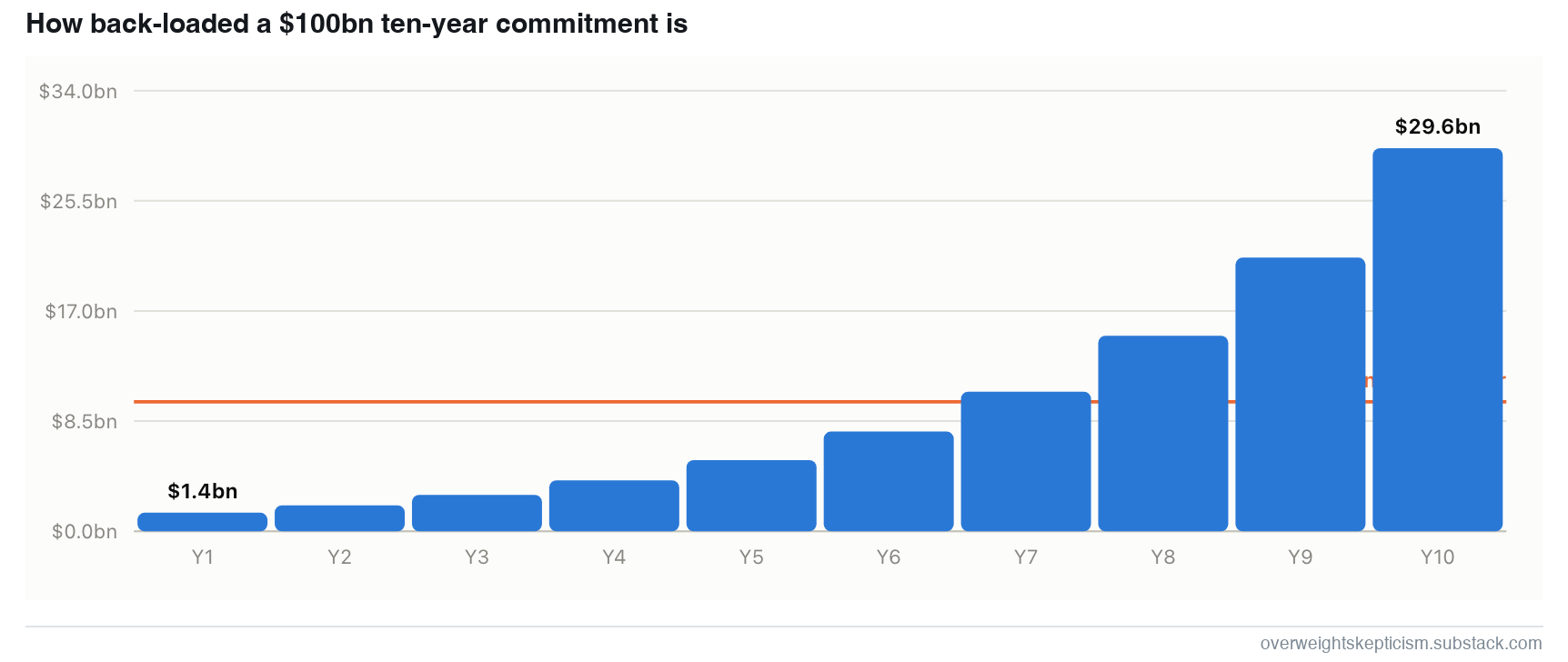
What a "$100bn over 10 years" commitment actually books, year by year, at different compound consumption growth rates. This is a model of how consumption plans get built in practice, a starting run rate and a growth assumption solved so the cumulative total hits the contracted number. It is not a disclosure and it is not a forecast. The straight line is what the headline implies; every commitment I ever signed sat well to the right of it.
The significance is that the vast majority of the revenue arrives towards the end of the contract.
How It Shows Up in the Financial Statements
AWS discloses two figures every quarter, one sentence apart. The backlog, which everyone seems to be quoting. And the weighted-average remaining life of the contracts inside it, which I have not seen anyone use.

Amazon.com Inc., Form 10-Q for the quarter ended 30 June 2025, Note 1.
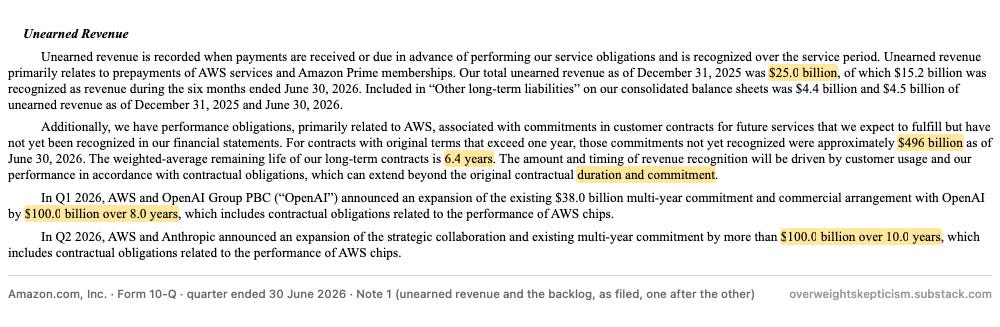
The same disclosure, one year later, shown with the unearned revenue paragraph that sits directly above it in Note 1. Backlog up 154%. Weighted-average remaining life up from 4.0 years to 6.4. The paragraph is longer than last year's because Amazon bolted the two mega-deals onto the end of it.
From those two disclosures you can work this out:
June 2025: $195bn at 4.0 years, giving 780 duration-weighted units.
June 2026: $496bn at 6.4 years, giving 3,174 units.
Backlog added over the year: $301bn. Duration-weighted value added: 2,394.
2,394 divided by 301 gives an implied weighted-average remaining life on the new money of 7.95 years.
A ten-year contract consumed evenly has a weighted-average life of 5.0 years. To drag a blended book from 4.0 up to 6.4, the new backlog has to sit at nearly eight. On ten-year terms that implies compound annual consumption growth of roughly 61%, which puts year one at about half a percent of the contract value.
Worth pausing on how strange a book with an eight-year weighted-average life actually is. A four-year figure, which is where AWS sat for eight consecutive quarters, is what a healthy enterprise book looks like. Migrations rolling through, renewals landing, contracts in every stage of their life at once. You know…. the usual enterprise SaaS/IaaS stuff. Nearly eight years is quite different in that these contracts are for capacity that doesn't exist yet. Probably waiting for grid connections in some cases. Amazon gestures at that in the same paragraph, twice, noting that both mega-deals include "contractual obligations related to the performance of AWS chips." Hell the chips probably don't even exist yet.
You can see the shift in the shape of the disclosure itself:
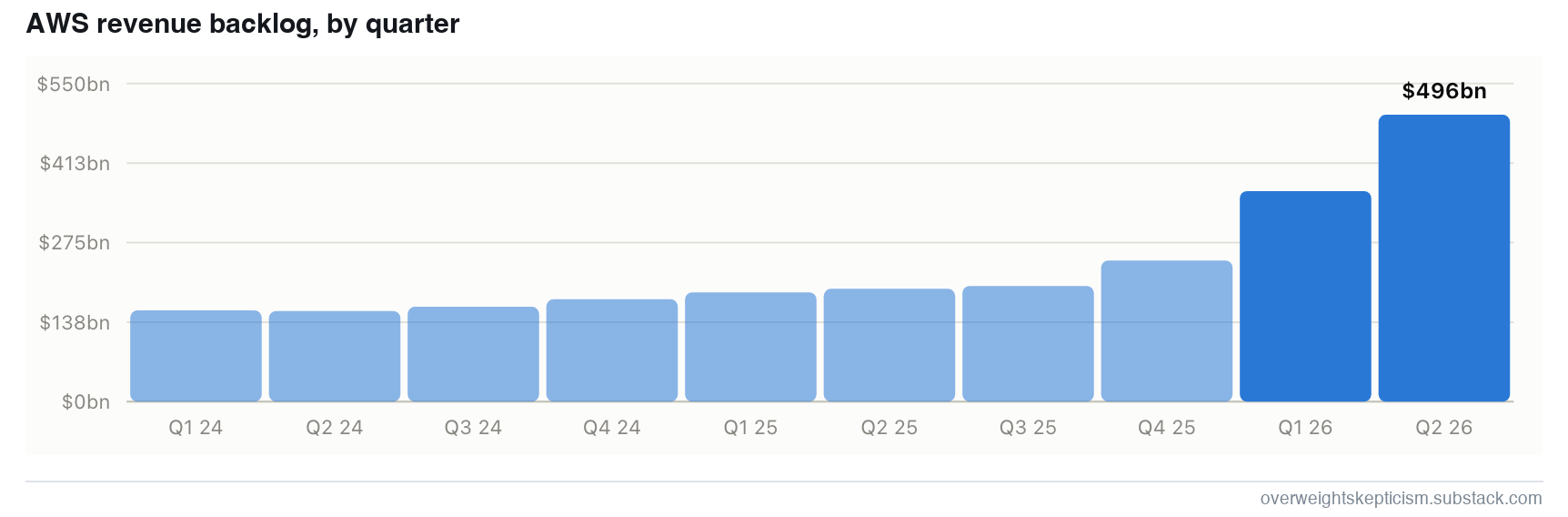
AWS commitments not yet recognised, from the Note 1 disclosure in every 10-Q and 10-K from Q1 2024 to Q2 2026.
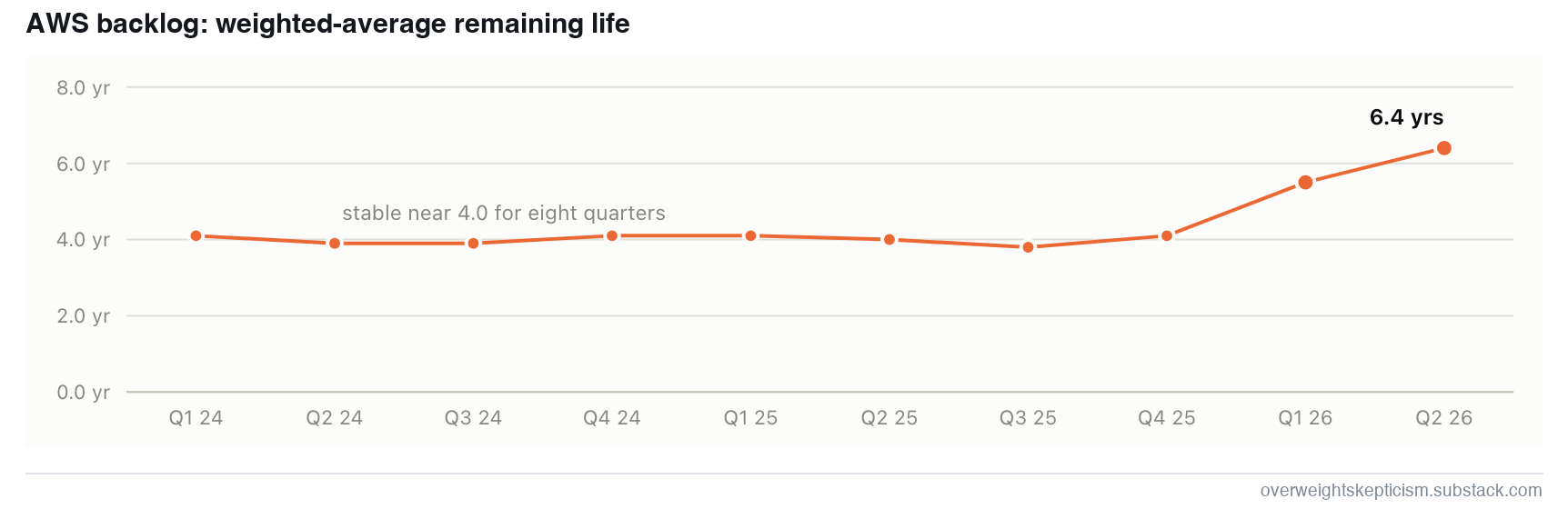
The same filings, the second number. Eight quarters of a stable four-year book, then two quarters that bend it to 6.4 years. The two panels share an x-axis and are deliberately kept apart; putting dollars and years on one plot with two scales would invent a relationship the data does not contain.
The backlog sat between $157bn and $200bn for seven straight quarters, from the start of 2024 through September 2025. Then it went to $244bn, then $364bn, then $496bn. It has more than doubled in the last two quarters alone. The weighted-average remaining life held between 3.8 and 4.1 years across that same two-year stretch, then went to 5.5 and then to 6.4.
Be careful about what this actually proves. The 6.4 years is a blended figure across the entire AWS long-term book. The mix of contract terms inside the new $301bn is not disclosed, and the calculation assumes the metric is computed consistently from period to period. It also treats the pre-existing book as though it sat still for a year, when in reality it both shrank as contracts were consumed and shortened as they aged. Rerunning it with that book down to $155bn at 3.2 years gives 7.85 rather than 7.95. Assume something far more aggressive, half the entire old book consumed inside twelve months, and it still only falls to about 7.0. Amazon changed the language around the disclosure in 2026 while the definition appears unchanged, but if the methodology moved too, this needs revisiting. The 61% should not be read as a precise estimate of Anthropic's consumption ramp.
What it does establish, robustly, is direction and magnitude. The backlog AWS added over the last twelve months is dramatically more back-loaded than the book it already had, which is consistent with how these deals got signed when I was on the other side of the table. Confirmed by Amazon, in some sneaky footnotes.
Is Any of It Paid Up Front?
These deals are (normally) structured so that invoices follow consumption. So let us see whether that shows up in the financials too.
Backlog is a promise about future business. Deferred revenue is cash that has already left the customer's bank account for a service not yet delivered. If the mega-deals came with real money up front, deferred revenue would be climbing alongside the backlog.
Amazon's entire company-wide unearned revenue balance is $24.9bn at 30 June 2026, against a $496bn AWS backlog. Twenty dollars of commitment for every dollar of cash.

"Unearned revenue primarily relates to prepayments of AWS services and Amazon Prime memberships." Amazon.com Inc., Form 10-Q, Q2 2026, Note 1. The $25.0bn shown is the 31 December 2025 balance; at 30 June 2026 it was $24.9bn.
Amazon does not split that balance, and the note says it "primarily relates to prepayments of AWS services and Amazon Prime memberships," so some unknown share of it is people paying for next-day delivery. But the split does not actually matter to the argument. Even if every cent of the $24.9bn were AWS prepayment, it would still cover 5% of the backlog.
Prepayment does happen in enterprise cloud now and again, but when it happens a customer wants an extra few points of discount badly enough to hand over cash a year early, usually at a year end because someone's budget is about to expire. Those deals absolutely exist and I signed a few. They are usually small relative to the commitment though, and if a wave of $100bn contracts had come with even single-digit prepayment percentages attached, you would see it in this line immediately. You do not.
Microsoft tells the same story with more precision, because it breaks deferred revenue out by segment. Intelligent Cloud deferred revenue went from $14.022bn to $14.942bn over the year, an increase of 6.6%. Over that same year, commercial remaining performance obligations grew 84%, to $678bn. Forty-five dollars of commitment for every dollar of cash.
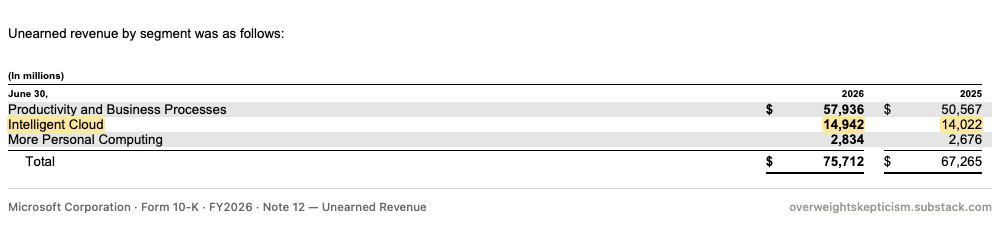
Microsoft Corporation, Form 10-K for the fiscal year ended 30 June 2026, Note 12. Intelligent Cloud, the segment carrying the AI commitments, grew its deferred balance 6.6%. Productivity and Business Processes, which sells Office licences a year at a time, grew 14.6%.
The segment comparison is the most telling part. Productivity and Business Processes, the segment that sells Office, grew its deferred revenue 14.6% over the same twelve months. That is a different business selling software licences, where customers typically pay a year up front. The old software business is collecting cash in advance more than twice as fast as the segment holding the AI deals.
There is one more disclosure worth pulling out. Because Microsoft holds roughly 25% of OpenAI on an as-converted basis, OpenAI is a related party, and the related-party note discloses $6.0bn of receivables against $24.1bn of OpenAI revenue for the year. That is 91 days sales outstanding on the full-year figure, and less against a current run rate, because the spend climbed all year. Either way, Microsoft is carrying months of OpenAI's compute bill as an unpaid invoice. Money owed to Microsoft, not money banked by Microsoft.
How Strong Are These Commitments?
I said earlier that both sides know a shortfall becomes a bargaining chip at renewal. That is the sort of thing that lives in renewal negotiations, not in a public filing. But..... Microsoft just put it in a 10-Q. This language first appears in the Q2 FY2026 10-Q, covering the December 2025 quarter, and is absent from every prior period:
"Estimating revenue that will be allocated to remaining performance obligations can involve significant judgments, including identifying and assessing variable consideration and potential renegotiation of commitments."

Microsoft Corporation, Form 10-Q for the quarter ended 31 December 2025. This language does not appear in any earlier filing.
The prior quarter's version of that note, from September 2025, contains nothing of the kind. It gives the RPO figure, the commercial portion, states the twelve-month percentage, and stops. No "judgement", no "variable consideration", no "renegotiation".
Let me translate the accounting-speak. "Identifying and assessing variable consideration" means we are not certain how much of this the customer will actually take. "Potential renegotiation of commitments" means we are not certain the contract will still say what it says today. When a company starts telling you its backlog estimate depends partly on whether the contracts get renegotiated, it is telling you the backlog is softer than the number implies.
In the same quarter, Microsoft's disclosed twelve-month conversion rate, the share of backlog it expects to recognise as revenue within a year, fell from 40% to 25%. It had not been below 40% in the two years before that. A weighted-average duration metric appeared for the first time. So, there have been three changes to one note in one quarter, and it was the quarter in which the restructured OpenAI agreement landed on the books with an incremental $250bn Azure commitment.
This is Microsoft's own forecast of its own revenue from its own contracts, and in that quarter it was telling us three-quarters of a record backlog would land beyond the next twelve months. It has since edged back to 30%, which you can see below, and which still leaves it well under where it sat a year earlier.
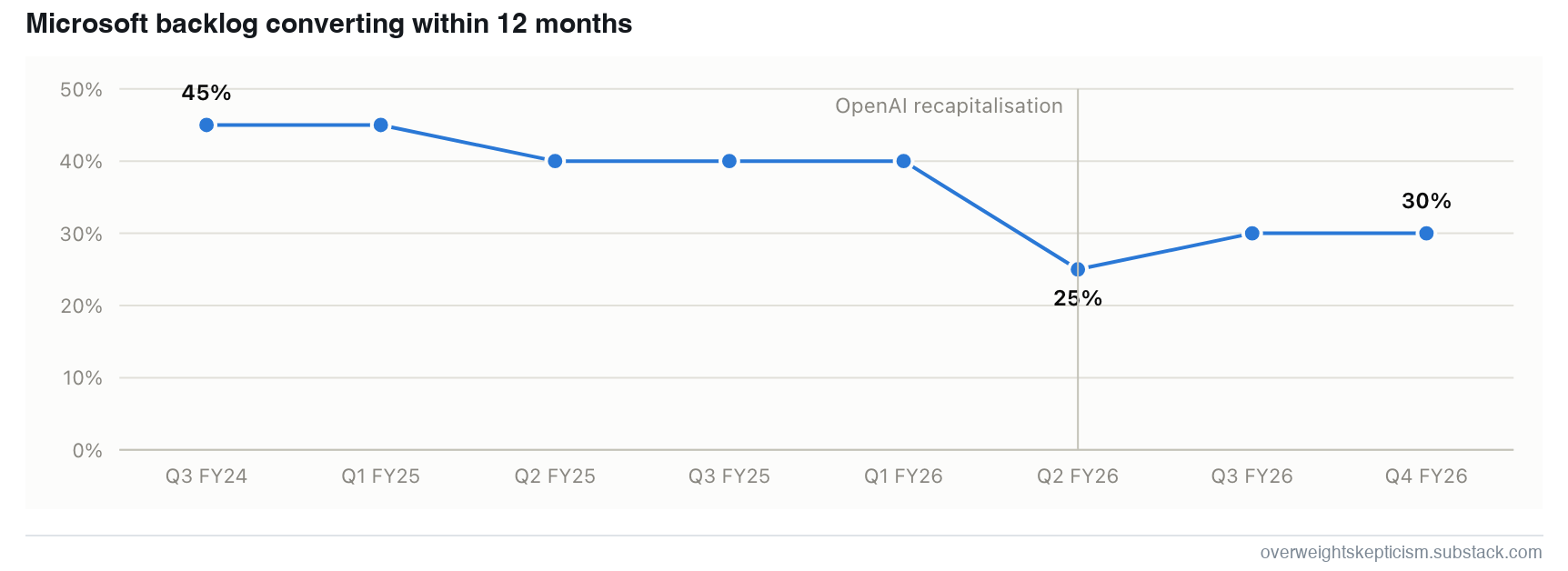
Microsoft 10-Q and 10-K revenue notes, Q3 FY2024 to Q4 FY2026. Total-company figures throughout, because that is the only continuous series: before Q2 FY2026 Microsoft disclosed a single percentage. Where total and commercial diverged, in Q3 FY2026, the cloud-relevant commercial line was worse, at 25% against 30%.
Amazon rewrote its own recognition sentence in the same window, so that revenue may now run "beyond the original contractual duration and commitment," which is Amazon conceding that recognition can outlive the commitment itself. Alphabet quietly added "contract duration" to its list of recognition drivers, where it had not been before.
It's interesting that three companies made the change in the same accounting period. Perhaps their accounting departments spontaneously developed the same anxiety in the same ninety days.
So What Is the Actual Exposure?
OpenAI had been an equity-method investee of Microsoft's for years. What the October 2025 recapitalisation changed is that Microsoft now had to put a number on the related-party revenue under ASC 850, having previously disclosed only the relationship. So the single audited lab-revenue figure available to anyone sits in Note 1 of a 10-K. The gospel according to Microsoft: "In accordance with ASC 850, we are disclosing revenue and accounts receivable balances from transactions with OpenAI."
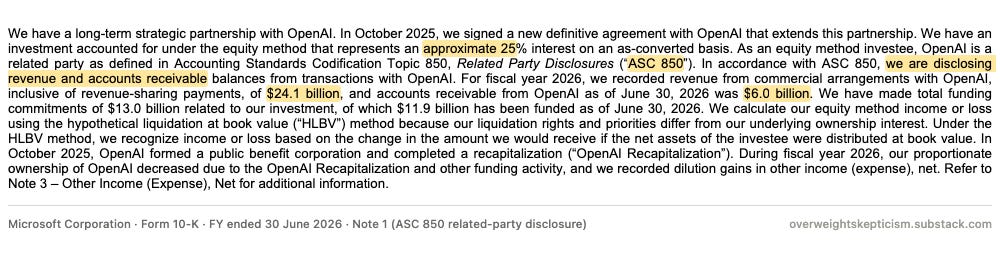
Microsoft Corporation, Form 10-K for the fiscal year ended 30 June 2026, Note 1. The only audited lab-revenue figure in the sector, disclosed under protest.
Microsoft booked $24.1bn of revenue from OpenAI in FY2026. That is 11.2% of all Microsoft Cloud revenue, and it is a large number. It also, per the disclosure, includes revenue-sharing payments, so it overstates pure Azure consumption, probably by a few billion. Microsoft does not split the two apart, so we cannot get closer than that.
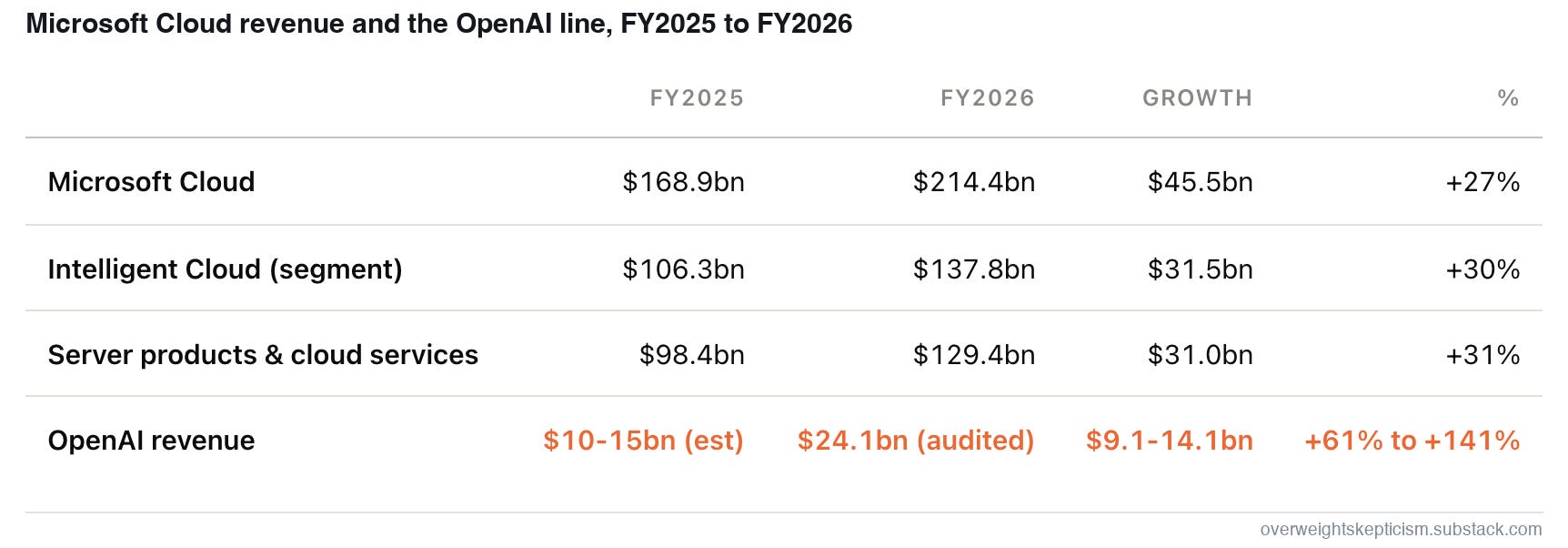
Every row except the OpenAI FY2025 base is straight off the FY2026 10-K. That base is an estimate because the disclosure only began with the recapitalisation, so there is no prior-year comparative. I have anchored it on the $17.2bn OpenAI reportedly paid Microsoft across calendar 2025, adjusted back for a fiscal year ending six months earlier against a spend profile that was ramping hard throughout.
Which gives this:
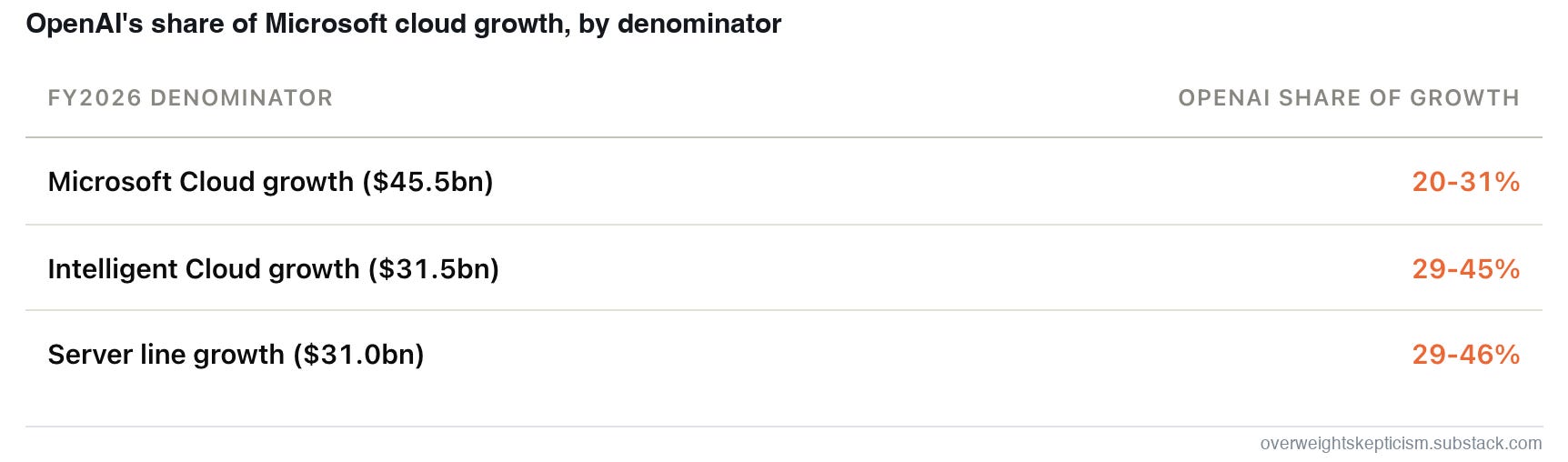
So OpenAI is somewhere between 20% and 46% of Microsoft's incremental cloud revenue, depending on which denominator you pick and where the FY2025 base actually sat. Roughly half that spread is the denominator choice and roughly half is the undisclosed base. I cannot narrow the second half, and neither can anyone else until Microsoft gives us a comparative.
That is a good deal lower than the 60-70% figures in circulation, so I went looking for where those come from.
The most-quoted version is 69% of Intelligent Cloud's growth, with the segment growing 8% once OpenAI is stripped out. Both numbers reproduce almost exactly once you find the construction. Take OpenAI's full calendar-2025 bill to Microsoft, reportedly $17.2bn. Divide it by the growth in Intelligent Cloud revenue across calendar 2025, which I reconstruct from the quarterly filings at $24.8bn, from $95.6bn to $120.4bn. That gives 69.4%. Strip the same $17.2bn out of 2025 and compare against an unadjusted 2024, and segment growth falls to 8.0%.
The arithmetic is fine. The construction is the problem. It takes OpenAI's entire annual bill and treats all of it as new revenue, which only works if OpenAI spent nothing with Microsoft in 2024. It spent billions. My own FY2025 estimate of $10-15bn runs from July 2024 to June 2025, so six months of it sit inside calendar 2024. On a smooth ramp that implies $6-13bn of calendar-2024 spend, and once you take that off both years, growth ex-OpenAI lands somewhere around 15-25% rather than 8%.
This is a significant customer for Microsoft. It is not an overwhelming one. If OpenAI suddenly disappeared, Microsoft would still be fine, and Azure would still be a solid business.
Google Is Where the Concentration Actually Is
Alphabet's disclosure is worse and its concentration is worse.
What it does disclose is the backlog, which is an interesting read (for an accountant like me at least). Google Cloud's revenue backlog is $513.9bn against a $99bn annualised run rate, a coverage ratio of 5.2 times, by far the highest of the three.
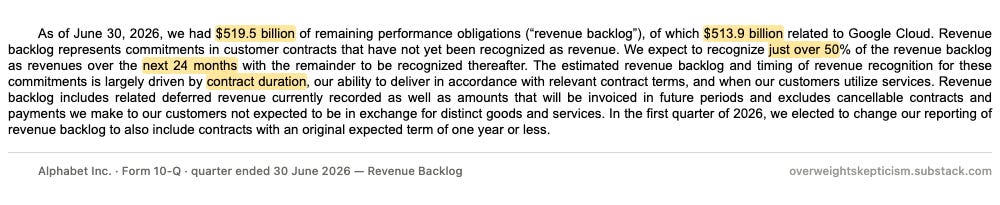
Alphabet Inc., Form 10-Q for the quarter ended 30 June 2026. Read the last sentence: in Q1 2026 Alphabet elected to start including contracts with an original expected term of one year or less. Some of the backlog growth is that definitional change rather than new commitments, and Alphabet does not quantify the split.
If UBS's estimate that the labs are 27% of Google Cloud revenue in 2026 is right, the labs supplied roughly 40-53% of Google Cloud's revenue growth over the last year.
Then there is Alphabet's own footnote, which I keep re-reading. "Just over 50%" of the $519.5bn total backlog, almost all of which is Google Cloud, is expected to be recognised "over the next 24 months". That works out at roughly $130bn a year of backlog-sourced cloud revenue, against a current Google Cloud run rate of $99bn. Alphabet is telling you it expects revenue from already-contracted business alone to run about 30% above everything Google Cloud is billing today. And it rests on a single customer the filing will not name, though we all know who it is.
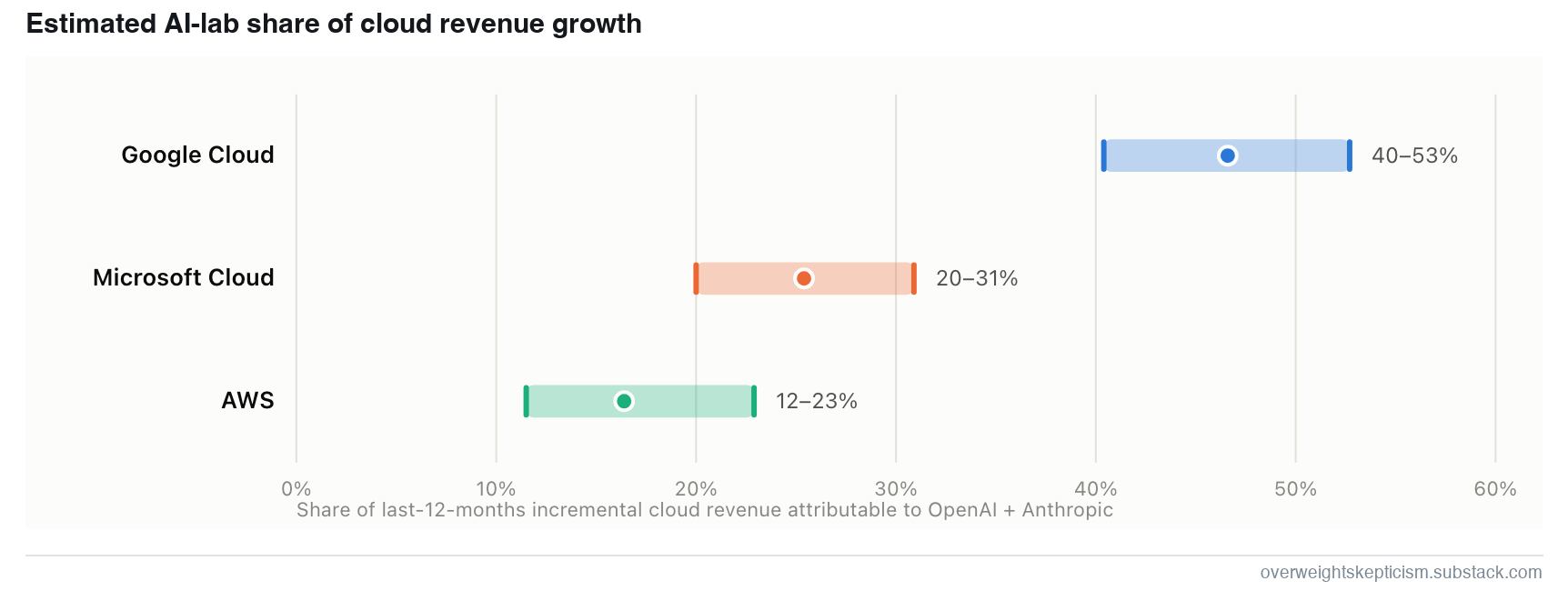
Ranges, not points, because only Microsoft discloses anything at all. Microsoft's range comes from the undisclosed prior-year base. Google's rests on the UBS lab-share estimate and is an estimate throughout. AWS's comes from Anthropic's estimated total compute spend and its split across vendors, and carries the widest error bars of the three.
So What Does All of This Mean
Four things, none of which require anybody to default.
The contracts are real, but they are mostly planned for the future. An eight-year weighted-average life on the backlog AWS added last year means a contract signed in 2026 does its heavy lifting somewhere around 2034. Every dollar can be collected in full, on time, from a perfectly solvent customer, and the income statement still will not show much of it for years.
Backlog growth has been read as revenue growth for about a year now. A $100bn headline is a terminal-year number. It has been relayed as an annual one.
Rank the hyperscalers by backlog and you get the concentration ordering backwards. AWS has the biggest, longest and most lab-heavy book in the industry, and almost none of it is converting yet. Google Cloud, which attracts a fraction of the scrutiny, is the one carrying genuine customer concentration, and it will not name the customer.
Almost none of it has been paid for. Twenty dollars of commitment for every dollar of cash at Amazon, forty-five at Microsoft, and an Office business collecting cash in advance more than twice as fast as the segment holding the AI deals.
So my position ended up different from where I expected it to land. The bear case is that these contracts break because OpenAI and Anthropic never find enough end customers, and that the revenue inside Azure, AWS and GCP is therefore not robust. On Microsoft's audited numbers, that risk is real and it is smaller than advertised: 20-31% of the growth of the largest cloud business on earth, not 69%. On Alphabet's numbers it is bigger than I've seen anybody pricing, and the disclosure is thin enough that you have to take an analyst's word for it. And on Amazon's numbers the question barely applies yet, because the book it keeps getting credited for has hardly started converting.
The thing I would actually watch is not a default. It is a renegotiation. Microsoft has already told you, in its own revenue note, that it is thinking about one.
Sources: Amazon.com Inc., Form 10-Q Q2 2026 (filed 31 July 2026), Note 1, and the 10-Q/10-K series back to Q1 2024, for the backlog, weighted-average remaining life and unearned revenue. Microsoft Corporation, Form 10-K FY2026 (filed 29 July 2026), Notes 1 and 12 and MD&A, for the ASC 850 OpenAI disclosure, unearned revenue by segment, remaining performance obligations and Microsoft Cloud revenue, plus Forms 10-Q Q3 FY2024 through Q3 FY2026 for the conversion-rate series and the December 2025 renegotiation language. Alphabet Inc., Form 10-Q Q2 2026 (filed 23 July 2026), Revenue Backlog note, and the FY2025 10-K. UBS lab-share estimates for Google Cloud as cited in press coverage, July 2026. Calendar-year Intelligent Cloud figures are my own reconstruction from Microsoft's quarterly segment disclosures on the post-August-2024 recast basis. The 7.95-year implied duration, the 61% implied consumption growth, the coverage ratios and the attribution ranges are my own arithmetic on the disclosures above; the Google attribution figures are estimates and are labelled as such.
Not investment advice. For informational purposes only. Do your own research. See full disclaimer for terms.
Great read! I will be featuring this as one of the articles in my weekly Obsidian Edit where I select the best reads of the week on Substack!
Amazing read with full of insights. Thank you!